Security for CompTIA A+
This page covers the Security domain of the CompTIA A+ certification. Master Cybersecurity offers 80 practice questions in this domain, drawn from the same content we use across our timed exam simulations. Below are five sample questions with full answer explanations.
Sample Practice Questions
Question 1
A security administrator teaches all of an organization's staff members to use BitLocker To Go. Which of the following best describes the reason for this training?- A. To ensure that all removable media is password protected in case of loss or theft
- B. To enable Secure Boot and a BIOS-level password to prevent configuration changes
- C. To enforce VPN connectivity to be encrypted by hardware modules
- D. To configure all laptops to use the TPM as an encryption factor for hard drives
Explanation
The correct answer is: A. To ensure that all removable media is password protected in case of loss or theft.
BitLocker To Go is the Windows feature that encrypts removable media such as USB flash drives and external disks using a password or smart card, so if the device is later lost or stolen the data on it remains protected ciphertext that cannot be read without the unlock secret. Training staff to use it ensures that any sensitive files copied to portable storage are encrypted at the time they are written. Secure Boot and a BIOS-level password are firmware-level controls protecting the boot path of fixed systems, not removable media. Encrypting VPN traffic with hardware modules concerns data in transit through a tunnel, not the contents of a USB stick. Using the TPM as a factor for hard drive encryption refers to standard BitLocker on the system drive, which is a different feature aimed at internal disks. The training scenario is squarely about protecting removable media.
Question 2
Which of the following is used to detect and record access to restricted areas?- A. Bollards
- B. Video surveillance
- C. Badge readers
- D. Fence
Explanation
The correct answer is: C. Badge readers.
Detecting and recording who enters a restricted area requires identifying each person at the door and timestamping the access event, which is exactly what a badge reader does. As employees swipe or tap their credential, the access control system logs the user, the door, and the time, building an auditable record of every entry attempt and outcome. Bollards are physical barriers that prevent vehicle ramming but neither identify people nor produce access logs. Video surveillance does record movement at a door but it captures imagery rather than authenticated identities and lacks the structured event log that proves a specific person entered. A fence delineates a perimeter and may impede unauthorized ingress, yet it has no detection or recording function on its own. Badge readers paired with an access control system provide both the detect and record capabilities the question demands.
Question 3
Which of the following types of social engineering attacks sends an unsolicited text message to a user's mobile device?- A. Impersonation
- B. Vishing
- C. Spear phishing
- D. Smishing
Explanation
The correct answer is: D. Smishing.
Smishing combines SMS and phishing and refers specifically to social engineering delivered via unsolicited text messages, often containing a link, fake delivery notice, or password reset prompt that lures the user to a malicious site or to call a fraudulent number. Impersonation is a broader category in which the attacker pretends to be a trusted party such as IT or a vendor; the channel could be in person, phone, or email and is not defined by SMS. Vishing is voice phishing performed over a telephone call, where the attacker speaks to the victim rather than texts. Spear phishing is a targeted email campaign aimed at a specific individual or small group, again email-based rather than SMS-based. The text message channel uniquely identifies the attack as smishing.
Question 4
Which of the following describes a vulnerability that has been exploited before a patch or remediation is available?- A. Spoofing
- B. Brute-force
- C. DoS
- D. Zero-day
Explanation
The correct answer is: D. Zero-day.
A vulnerability that is exploited in the wild before the vendor has released a patch or even, in many cases, before the vendor knows about it is called a zero-day, named for the zero days defenders have had to prepare. Spoofing is a technique of forging identifying data such as IP, MAC, or email headers and is not specifically about unpatched flaws. Brute-force is an attack that systematically guesses credentials and does not depend on any vulnerability being unpatched. Denial-of-service overwhelms a service to make it unavailable, and while a DoS may exploit a flaw, it does not by itself imply the no-patch-yet condition. The unique characteristic in the question, an exploit landing before remediation exists, is the textbook zero-day situation.
Question 5
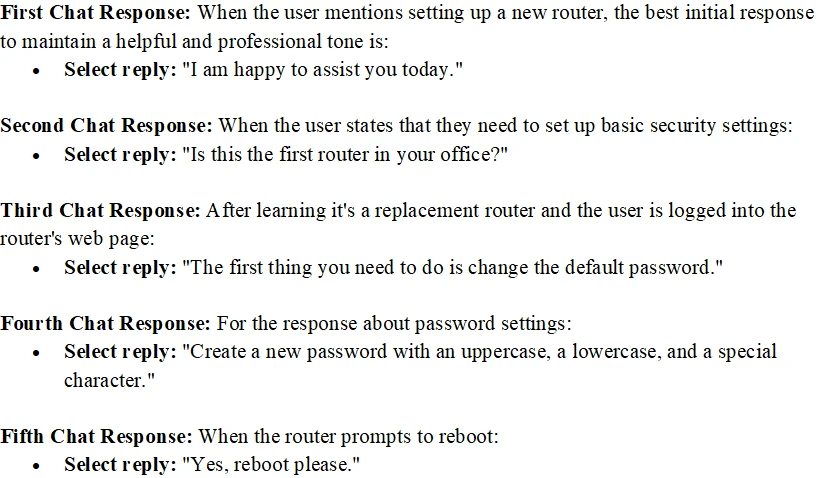
SIMULATION - You have been contacted through the help desk chat application. A user is setting up a replacement SOHO router. Assist the user with setting up the router. INSTRUCTIONS - Select the MOST appropriate statement for each response. Click the send button after each response to continue the chat. If at any time you would like to bring back the initial state of the simulation, please click the Reset All button.Explanation
Other CompTIA A+ domains
- Operating Systems (102 questions)
- Operational Procedures (76 questions)
- Software Troubleshooting (92 questions)