Services for CCNA
This page covers the Services domain of the CCNA certification. Master Cybersecurity offers 135 practice questions in this domain, drawn from the same content we use across our timed exam simulations. Below are five sample questions with full answer explanations.
Sample Practice Questions
Question 1
Explanation
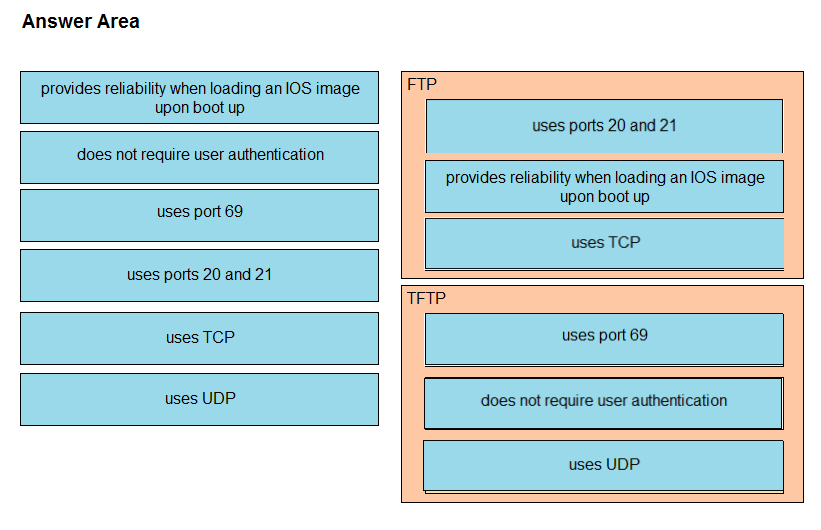
Question 2
Explanation
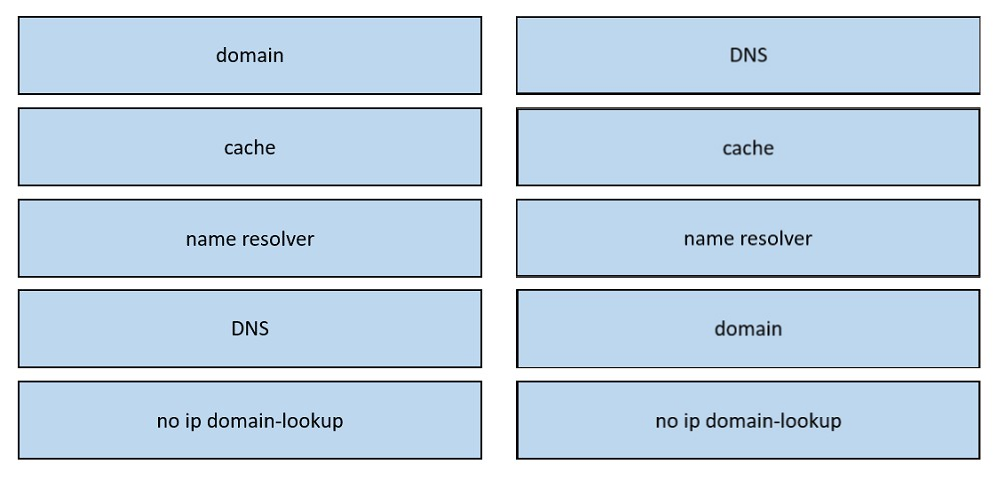
Question 3
- A. Platinum
- B. Bronze
- C. Gold
- D. Silver
Explanation
The correct answer is: A. Platinum.
Cisco Unified Wireless Network controllers offer four named QoS profiles that map directly to the four 802.11e access categories used on the air: Platinum maps to Voice (AC_VO), Gold maps to Video (AC_VI), Silver maps to Best Effort (AC_BE) and is the default profile, and Bronze maps to Background (AC_BK). Voice over WLAN traffic is the most sensitive to delay, jitter, and loss of any application a wireless network typically carries, so it needs the highest-priority access category and the strictest channel-access timing, which the Platinum profile provides. That is why Platinum is the correct selection for a voice-over-WLAN deployment in the WLC GUI. Bronze is at the opposite end of the scale, mapped to background traffic such as bulk file movement, and would give voice the worst possible airtime treatment, almost guaranteed call quality problems. Gold is intended for video, which tolerates more jitter than voice, and it has lower channel-access priority than Platinum so voice on Gold would still queue behind Voice-category traffic. Silver is the default for general data and gives voice no preferential treatment at all.
Question 4
- A. IP routing must be enabled on the switch.
- B. A console password must be configured on the switch.
- C. Telnet must be disabled on the switch.
- D. The switch must be running a k9 (crypto) IOS image.
- E. The ip domain-name command must be configured on the switch.
The correct answers are: D. The switch must be running a k9 (crypto) IOS image., E. The ip domain-name command must be configured on the switch..
SSH on Cisco IOS depends on cryptographic primitives that are only present in K9/crypto-feature images, and it needs a hostname plus an IP domain name in order to generate the RSA key pair used to secure the session. D is correct because non-K9 IOS images do not include the SSH server at all. E is correct because the `crypto key generate rsa` step requires a fully-qualified domain name (`ip domain-name `); without it, key generation fails. A is wrong because SSH operates at the application layer over TCP/22 and does not require IP routing on the local switch. B is wrong because a console password is an unrelated authentication path; SSH uses local users, line passwords, or AAA. C is wrong because Telnet and SSH can coexist on the same VTY lines (with `transport input ssh` to restrict to SSH only); disabling Telnet is a hardening choice, not a precondition.Question 5
- A. LLDP
- B. EEM
- C. CDP
- D. NTP
Explanation
The correct answer is: D. NTP.
IP SLA's UDP jitter probe measures one-way and round-trip jitter by timestamping packets at sender and responder; for those timestamps to be meaningful the two endpoints must have synchronized clocks, which is what NTP provides. D is correct. A (LLDP) is a Layer-2 neighbor-discovery protocol. B (EEM) is the Embedded Event Manager for scripting events; it can react to SLA results but doesn't enable jitter measurement. C (CDP) is Cisco's Layer-2 neighbor-discovery, also unrelated to time synchronization.Other CCNA domains
- Automation and Programmability (83 questions)
- IP Connectivity (256 questions)
- Network Access (217 questions)
- Network Fundamentals (505 questions)
- Security Fundamentals (108 questions)