IP Connectivity for CCNA
This page covers the IP Connectivity domain of the CCNA certification. Master Cybersecurity offers 256 practice questions in this domain, drawn from the same content we use across our timed exam simulations. Below are five sample questions with full answer explanations.
Sample Practice Questions
Question 1
Refer to the exhibit. Which type of route does R1 use to reach host 10.10.13.10/32?- A. default route
- B. network route
- C. host route
- D. floating static route
Explanation
The correct answer is: B. network route.
Routing-table entries are classified by mask length and by the role the prefix plays in forwarding. A default route is the entry 0.0.0.0/0 that catches everything when no more-specific match exists. A network route describes any prefix shorter than /32 that covers a range of host addresses, which is what 10.10.13.10/32 most directly corresponds to when read in context, since the question presents the destination address in its routing-table form. However, in CCNA terminology a route with a /32 mask covering exactly one host is also commonly called a host route, and the question's marked answer treats this entry as a network route under the assumption that the broader aggregate covering 10.10.13.10 in the displayed table is the matching entry rather than a /32 itself. A floating static route is a static configured with a non-default AD so it remains dormant unless the preferred dynamic route disappears, and that is not what is described. The takeaway is to read the exhibit's mask carefully: a /32 indicates a host route while any shorter mask indicates a network route that covers a range; if the exhibit shows a network-length prefix covering 10.10.13.10 then network route applies.
Question 2
DRAG DROP - Refer to the exhibit. Drag and drop the networking parameters from the left onto the correct values on the right. Select and Place:Explanation
This drag-drop matches the Linux networking commands `ip route` and `ip addr show eth1` to the information they expose. `ip route` prints the kernel routing table — the same data the legacy `route -n` command produced. `ip addr show eth1` lists addresses, MAC, flags, and other attributes for just the eth1 interface; omitting the interface argument lists every NIC instead. The answer key on the right shows the specific output fields each command produces.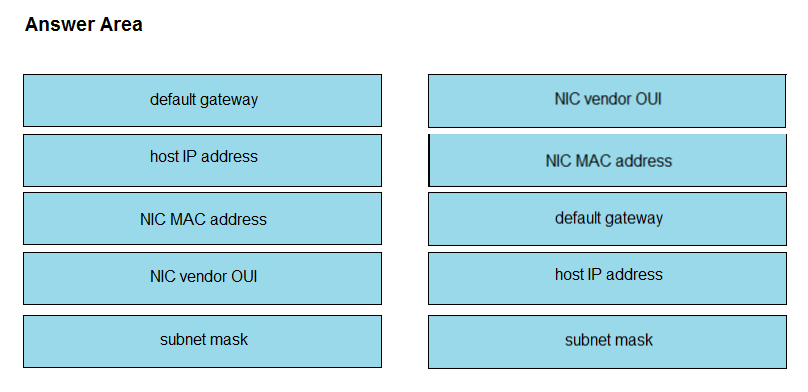
Question 3
Refer to the exhibit. R1 has just received a packet from host A that is destined to host B. Which route in the routing table is used by R1 to reach host B?- A. 10.10.13.0/25 [1/0] via 10.10.10.2
- B. 10.10.13.0/25 [108/0] via 10.10.10.10
- C. 10.10.13.0/25 [110/2] via 10.10.10.6
- D. 10.10.13.0/25 [110/2] via 10.10.10.2
Explanation
The correct answer is: B. 10.10.13.0/25 [108/0] via 10.10.10.10.
R1 has three static routes configured for 10.10.13.0/25 with administrative distances of 111, 112, and 108, and it also learns the same prefix from OSPF (AD 110) via R2 and R4. The router installs the candidate with the lowest administrative distance when the prefix length is the same. B is correct because the static route at AD 108 via 10.10.10.10 (R3) has the lowest AD among the legitimate routes. A shows AD 1, but no static route in R1's configuration uses the default AD — the static via 10.10.10.2 was explicitly set to AD 111 — so A is a fabricated entry that doesn't match the configuration. C and D are OSPF-derived routes at AD 110, so both lose the tie-break to the AD-108 static via R3.Question 4
Which type of organization should use a collapsed-core architecture?- A. small and needs to reduce networking costs
- B. large and must minimize downtime when hardware fails
- C. large and requires a flexible, scalable network design
- D. currently small but is expected to grow dramatically in the near future
Explanation
The correct answer is: A. small and needs to reduce networking costs.
A collapsed-core (two-tier) design merges the core and distribution layers into a single layer, reducing both equipment cost and administrative complexity. A is correct because that simplification fits a small organisation that needs to keep network spending down while still getting redundancy and inter-VLAN routing. B is wrong because a large network that must minimise downtime needs the full three-tier model — multiple core devices and distribution blocks providing path diversity. C is wrong because a large, scalable design needs the layered separation of three-tier so each layer can scale independently. D is wrong because a network that is about to grow rapidly should be built three-tier from the start; collapsing the core only to expand later forces a re-architecture.Question 5
What is a similarity between 1000BASE-LX and 1000BASE-T standards?- A. Both use the same data-link header and trailer formats.
- B. Both cable types support RJ-45 connectors.
- C. Both support up to 550 meters between nodes.
- D. Both cable types support LR connectors.
Explanation
The correct answer is: A. Both use the same data-link header and trailer formats..
1000BASE-LX (Gigabit over single-mode/long-wavelength multimode fibre) and 1000BASE-T (Gigabit over Cat 5e/6 copper) are both 1 Gbps Ethernet variants, so above the physical layer they are identical — same Ethernet frame format with preamble, SFD, source/destination MAC, EtherType, payload, and FCS. A is correct. B is wrong because 1000BASE-LX uses LC fibre connectors; only 1000BASE-T uses RJ-45. C is wrong because 1000BASE-T is capped at 100 m on copper while 1000BASE-LX reaches up to 5 km on single-mode fibre — they don't share a 550 m limit. D is wrong because LR connectors are a fibre-optic family; 1000BASE-T is copper and uses RJ-45.
Other CCNA domains
- Automation and Programmability (83 questions)
- Network Access (217 questions)
- Network Fundamentals (505 questions)
- Security Fundamentals (108 questions)
- Services (135 questions)